7 Fascinating Facts About the Mars Odyssey Mission's 25th Anniversary Celebration
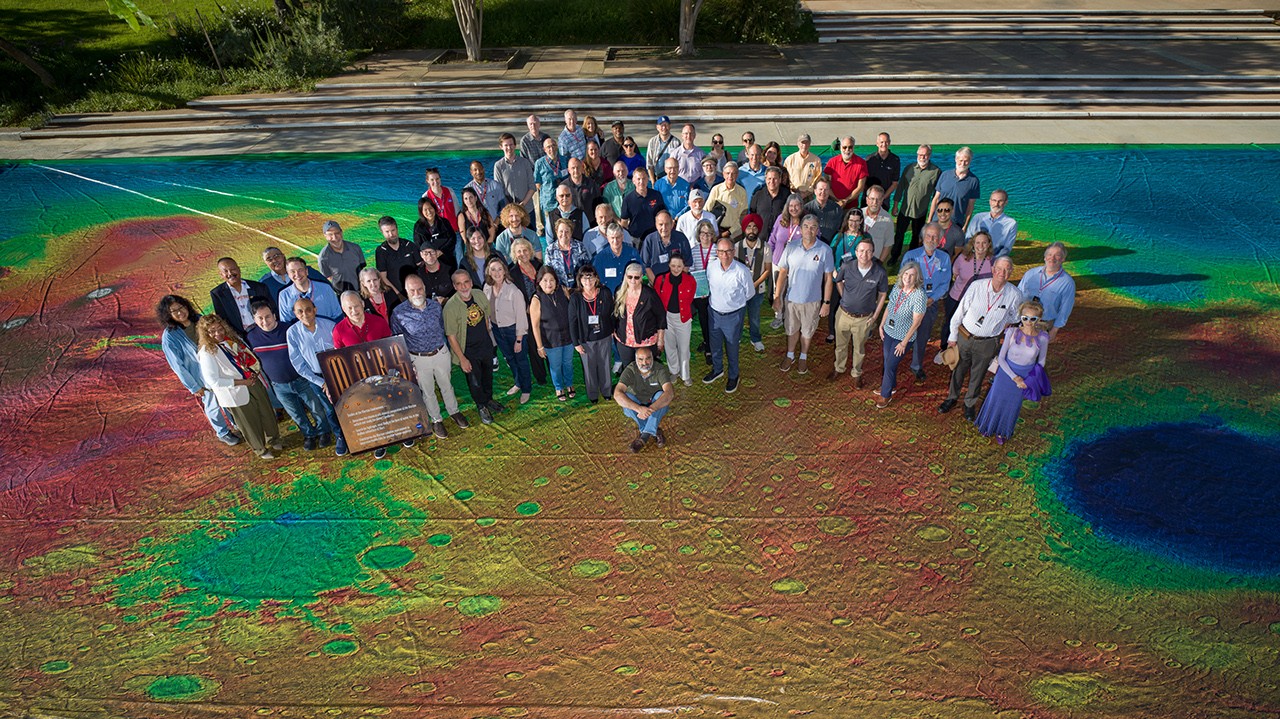
On April 15, 2026, a special gathering took place at NASA's Jet Propulsion Laboratory in Southern California. Team members—past and present—of the 2001 Mars Odyssey orbiter mission came together to mark a quarter-century since the spacecraft's launch on April 7, 2001. The centerpiece of the celebration was a massive global map of Mars, created from infrared images captured by Odyssey's THEMIS camera. This event not only honored the mission's longevity but also highlighted the incredible scientific achievements that have reshaped our understanding of the Red Planet. Below are seven key things you should know about this milestone.
1. A Quarter-Century of Orbital Science
NASA's 2001 Mars Odyssey orbiter launched on April 7, 2001, and entered orbit around Mars later that year. As of 2026, it has spent 25 years circling the Red Planet, making it one of the longest-running active missions at Mars. The spacecraft was originally designed for a primary mission of about two Earth years, but its robust design and continued scientific value have allowed it to operate far beyond expectations. Odyssey has provided invaluable data about the Martian surface, atmosphere, and climate, serving as a communication relay for rovers like Spirit, Opportunity, Curiosity, and Perseverance. The 25-year milestone is a testament to the engineering excellence and dedication of the mission team.
2. The Grand Map: A Mosaic of Infrared Visions
For the anniversary celebration, the Odyssey team unveiled a giant global map of Mars created using imagery from THEMIS (Thermal Emission Imaging System), the spacecraft's infrared camera. This map is not just a pretty picture—it's a scientific tool. THEMIS can detect variations in temperature and mineral composition, revealing features invisible to the naked eye. The mosaic combines thousands of infrared images taken over many years, providing a comprehensive view of the planet's geology. By rolling out this map at the celebration, the team showcased the mission's most iconic and far-reaching data product—a map that helps scientists study Martian volcanoes, canyons, and ancient water flows.
3. The Brains Behind THEMIS
The Thermal Emission Imaging System (THEMIS) was developed at Arizona State University under the leadership of Dr. Philip Christensen. It captures images in both visible and infrared wavelengths, but it's the infrared capability that sets it apart. By measuring thermal radiation emitted from the Martian surface, THEMIS can identify minerals such as carbonates, silicates, and sulfates. This data has been critical in identifying past water environments and potential landing sites for future missions. The instrument's longevity—still operating after 25 years—is remarkable, providing a continuous dataset that allows scientists to track seasonal changes and surface evolution.
4. Team Reunion at JPL
The celebration on April 15, 2026, was more than a meeting—it was a reunion. Engineers, scientists, and support staff who have worked on Odyssey over the decades gathered at NASA's Jet Propulsion Laboratory. Many had not seen each other in years. The event included presentations about the mission's legacy, a behind-the-scenes look at the new global map, and time for informal networking. The gathering underscored the human element behind robotic exploration: the passion and collaboration that keep a spacecraft operating for a quarter-century. Team members shared memories of the frantic launch preparations, early orbital insertion, and the joy of first data returns.
5. Why This Map Matters for Future Exploration
The global map created from THEMIS data isn't just a historical artifact—it's a living resource for Mars exploration. For example, the map helps mission planners identify safe landing zones for future rovers and landers by showing thermal inertia, which indicates surface rockiness and dust cover. It also aids in selecting sites for scientific study, such as ancient hydrothermal deposits. As NASA prepares for the Mars Sample Return campaign and eventual human missions, detailed maps like this one are essential for hazard avoidance and resource prospecting. Odyssey's data continues to inform every new mission, proving that a single orbiter can have a multigenerational impact.
6. The Legacy of Odyssey's Relay Services
One of Odyssey's unsung roles has been as a communication relay. Since 2004, it has supported U.S. and international landers and rovers by relaying data back to Earth. This service became especially critical during the missions of Spirit and Opportunity, and later for Curiosity and Perseverance. Without Odyssey, many of these rovers would have been limited in data return. The relay capability uses the UHF band and is designed to be robust and reliable. Even after 25 years, Odyssey continues to serve as a backup relay, ensuring that no data is lost from active surface missions. The team celebrated not only the science but also this vital infrastructure role.
7. Looking Ahead: One More Year (or More)
As of 2026, the Odyssey mission has been extended multiple times, with the latest extension likely taking it into at least 2027. However, the spacecraft shows no signs of stopping. The team continues to manage power and orbit carefully to maintain operations. Scientific observations are still being collected, and new discoveries are announced regularly. The 25-year milestone is a moment to reflect, but the mission pushes forward. Future plans include continued global mapping, seasonal monitoring, and relay support. The celebration was both a commemoration and a launchpad for the next chapter of exploration.
In conclusion, the 25th anniversary of the Mars Odyssey mission was more than a party—it was a celebration of human curiosity and engineering perseverance. The magnificent global map of Mars created from THEMIS data symbolizes the mission's incredible contributions to planetary science. As the spacecraft continues its silent vigil over the Red Planet, the team's reunion reminds us that behind every robotic explorer is a community of dedicated people. Here's to many more years of discovery.